
Date:2026-10-13 Categories:Product knowledge Hits:1948 From:Guangdong Youfeng Microelectronics Co., Ltd
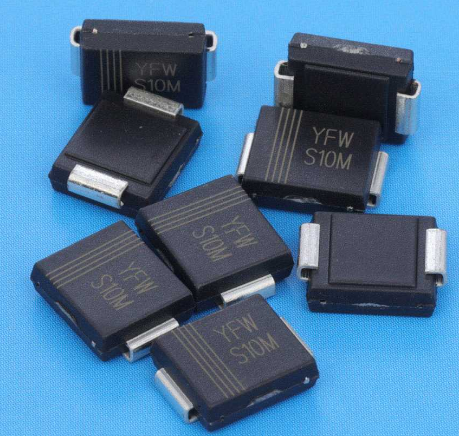
The Transient Voltage Suppression Diode, also known as the TVS diode, is an electronic device used to protect circuits from transient overvoltages. When operating in a circuit, it can quickly conduct and absorb transient overvoltages in the circuit, protecting other electronic components from damage.
1. Basic structure:
Transient voltage suppressors (TVS) typically consist of a PN junction structure, which is very similar to that of a regular diode. However, unlike regular diodes, TVS introduces an additional ion-doped region between the transistor and the base region. This extra doping region enables TVS to detect overvoltages in the circuit and quickly conduct.
II. Features:
Transient suppression diodes have the following characteristics:
1. Fast response speed: Transient suppression diodes can respond to transient overvoltages within nanoseconds, protecting other electronic components from damage.
2. High breakdown voltage: Transient suppression diodes have a high breakdown voltage, capable of withstanding large transient overvoltages.
3. Low leakage current: Transient voltage suppressors (TVS) exhibit a low leakage current under normal operating conditions, ensuring no impact on the normal operation of the circuit.
4. High energy absorption capacity: Transient suppression diodes are capable of absorbing significant amounts of energy, protecting other electronic components from energy surges.
III. Working Principle:
The working principle of a Transient suppression diode is based on the Zener effect and breakdown effect. When the voltage is within its forward operating range, it behaves like an ordinary diode. However, when the voltage exceeds its threshold voltage (often referred to as the breakdown voltage), the transient suppression diode will automatically conduct, forming a low-resistance path that conducts the overvoltage to ground or another grounding point.
Within its normal operating range, the transient suppression diode is in a high-impedance state and only becomes conductive when the voltage exceeds a specific threshold. Once conductive, its resistance value rapidly decreases to an extremely low level, allowing it to quickly absorb the overvoltage and direct it to ground. When the overvoltage disappears, the Transient suppression diode automatically reverts to its high-impedance state, waiting for the next overvoltage event.
IV. Specifications:
The specifications of Transient suppression diodes mainly include:
1. Rated Standoff Voltage: The rated standoff voltage of a transient voltage suppressor diode refers to the maximum forward voltage it can withstand. This value is usually given in the data sheet.
2. Peak Pulse Current Rating: The maximum pulse current that a transient voltage suppressor (TVS) diode can withstand, typically measured in amperes (A). This value is used to evaluate the diode's performance capability during breakdown.
3. Peak Pulse Power Dissipation: The maximum pulse power that a Transient suppression diode can withstand, typically measured in watts (W). This value is used to evaluate the diode's energy absorption capacity during breakdown.
4. Response Time: The response time of a transient suppression diode refers to the time it takes for it to transition from its normal operating state to its conducting state. The smaller this value, the better, indicating that the transient suppression diode can respond to overvoltage events more quickly.
5. Package type: Transient suppression diodes come in various package types, such as SMA, SMB, SMD, etc. Choosing the appropriate package type depends on application requirements and space constraints.
V. Application:
Transient suppression diodes are widely used in various electronic devices and circuits to protect them from damage caused by transient voltage interference. Here are some common application areas:
1. Communication equipment: TVS diodes are commonly used to protect communication equipment such as telephone lines, fiber-optic communication, and network devices from damage caused by factors such as lightning strikes and electromagnetic interference.
2. Power supply and electrical equipment: TVS diodes are widely used in power supply circuits, power adapters, switching power supplies, motor drivers, and other equipment to protect them from power fluctuations, overvoltages, and electromagnetic interference.
3. Automotive electronics: TVS diodes are used in automotive electronic systems to protect electronic control units (ECU), sensors, ignition systems, and other devices from damage caused by issues such as starting, short circuits, and overvoltage in automotive circuits.
4. Industrial control: TVS diodes are widely used in industrial automation equipment, PLC (Programmable Logic Controller), and other industrial control devices to protect the equipment from power line interference, electromagnetic wave interference, and voltage surges.
5. Household appliances: TVS diodes are used in power and signal circuits of household appliances such as televisions, refrigerators, air conditioners, washing machines, etc., to prevent damage to the equipment caused by overvoltages due to grid failures and lightning strikes.
VI. Instructions for Use:
When using TVS diodes, the following points should be noted:
1. Choose the appropriate specifications: Based on the application scenario and requirements, select the suitable TVS diode specifications, including maximum operating voltage, rated power, breakdown voltage, response time, etc.
2. Correct connection method: Connect the TVS diode correctly to the circuit that needs protection, usually by connecting it in parallel to the input/output terminal of the protected component or circuit.
3. Ensure good grounding: Ensure that the TVS diode is well connected to the grounding wire to provide an effective current loop and achieve overvoltage protection.
4. Proper layout and installation: When arranging and installing TVS diodes, the distance between them and other components should be considered to minimize the impact of inductance and capacitance effects.
5. Regular inspection and replacement: Regularly inspect the working status of the TVS diode, and promptly replace it if any malfunction or failure is detected.
VII. Installation:
The installation of TVS diodes typically follows the following steps:
1. Cleaning: Before installation, ensure that the installation area is clean and free of dust and debris.
2. Positioning: Choose an appropriate location to install the TVS diode, ensuring that the distance between it and the component or circuit that needs protection is as short as possible.
3. Welding: Use appropriate welding tools to solder the TVS diode onto the circuit board. Pay attention to the welding time and temperature to avoid damaging the diode.
4. Connection: Connect the TVS diode correctly to the component or circuit being protected, ensuring a secure and reliable connection.
5. Testing: After installation, conduct necessary tests to ensure that the TVS diode works properly and can effectively suppress transient voltage interference.
VIII. Market Prospects:
With the increasing popularity and expanding application scope of electronic devices, the demand for transient voltage suppressors (TVS diodes) is also on the rise. Especially in fields such as communications, automotive electronics, and industrial control, the need for circuit protection is becoming more urgent. Therefore, the market prospect for TVS diodes is vast.
With the continuous advancement of technology, the performance of transient suppression diodes (TSDs) is also continuously improving, such as faster response time and stronger energy absorption capability. This enables TSDs to more effectively protect electronic devices and enhance the reliability and stability of the devices.
Furthermore, with the rapid advancement of electronic devices and intensifying market competition, the demand for circuit protection is continuously increasing. Consequently, the market demand for Transient suppression diodes will continue to grow, and it is expected to achieve greater development potential in the future.
Previous: Classification, Structure, and Principle of MOSFET
Next: No Results